Garden District
PrimRose Amphitheater
Where the Garden District performs for itself.
Read to Players
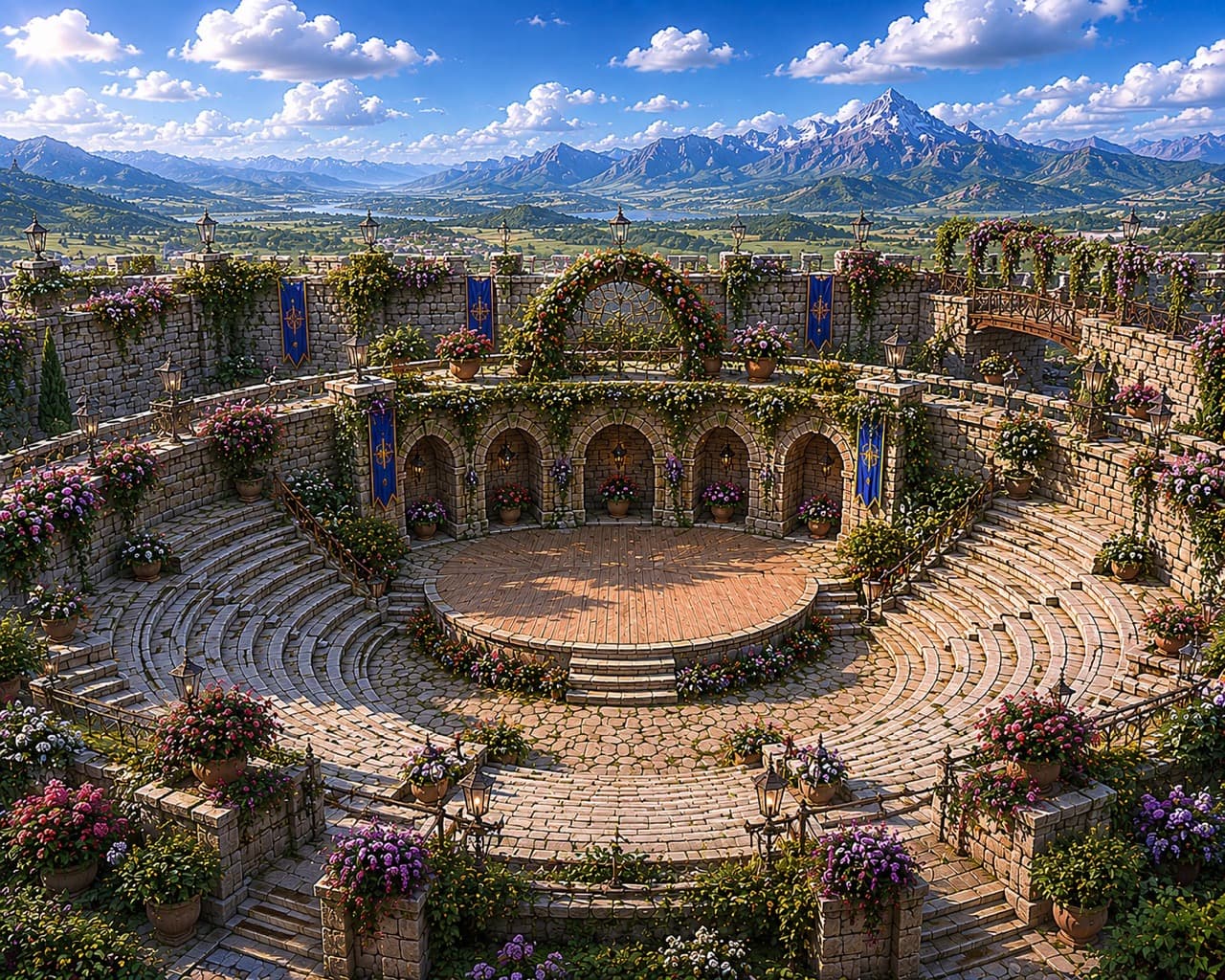
“At the far end of the Garden District, where the two ring roads bend toward each other and meet, the PrimRose Amphitheater sits sunken into the ground.
It is not a small thing. The seating curves three-quarters of the way around the stage — wide, stepped rows of pale stone that descend from street level down to the performance floor, each tier lined with potted flowers in reds and purples and whites. Decorative iron lanterns stand at intervals along the rows, low enough to light the audience without washing out the stage. At night, they make the whole bowl glow from within.
The stage itself is a circle of warm-toned paving stone, raised just slightly from the floor of the amphitheater on a shallow platform. Around its base, flowers press in close — hydrangeas, roses, clusters of lavender. Behind the stage, the back wall rises to the height of the outer city wall, and across the top of it, a walkway connects both sides of the seating. At the center of that walkway, a wide arch of woven vines and flowers frames the open sky above the place where the performers stand. Blue banners with gold hang from the pillars on either side of the stage, the symbol of the Garden District worked into the fabric.
Above the arch, above the back wall, the walkway of the Rooftop Garden Walk continues its path. From up there, the whole theater is visible at once — the flower-lined tiers, the round stage, and beyond the far wall, the open land stretching out toward the mountains.
The theater is open to the public. There is no gate, no ticketing, no guard at the entrance. The Garden District simply built it, and now it is here.”
DM Notes
The PrimRose Amphitheater has no permanent staff and no scheduled programming — the Garden District funds it as a shared space. Performers apply to use it. Most are approved.
Richard Baylor of Things You Didn't Know visits occasionally to give what he calls "informal lectures" on history, heroics, and the importance of the written word. He always has copies of his books nearby. He is a better speaker than most people expect, given that he looks like someone playing dress-up as a wizard. The crowd usually grows once he gets going.
The amphitheater is also used for music, theater, political addresses, and — once, memorably — a fencing demonstration that the Garden District residents still talk about. No one recorded who the fencer was.
The Rooftop Garden Walk passes directly above the back wall. Players standing on the walk can look down into the theater at whatever is happening below. This is intentional. The residents of the Garden District designed it that way. They wanted to be able to stop during a walk and hear the performance without committing to sitting down.